

Reflections on Vermont: Just Transformations in Food Systems and Cultures 2026
This post is written by Dr Anneli Löfstedt, postdoctoral researcher with the SHIFT project.
What does a just transformation in food systems actually look like in practice?
This question sat at the heart of the joint 2026 Agriculture, Food & Human Values Society (AFHVS) and the Association for the Study of Food and Society (ASFS) conference in Vermont, USA. The conference invited participants to explore how food systems can become more sustainable, equitable, and democratic while addressing the causes of food system injustices. I attended the conference to present research on the impact of food and drink reformulation on human health and the environment, and to learn how ideas of 'just transformation' are being applied in the US context. Across four days of discussions, research presentations and field visits, several themes emerged: adaptation, justice, and trust.
Food systems beyond the plate
One of the highlights of the conference was the keynote panel, which brought together leaders from Vermont's sustainable agriculture, regional development, and community food sectors. The conversation challenged the idea that food systems are simply about producing food. Instead, panellists explored how they can help address a wide range of social, environmental, and economic challenges. From supporting public health and strengthening local economies to improving community wellbeing, the discussion highlighted the far-reaching impact of food systems. It was a compelling reminder that the choices we make about food can shape not only what ends up on our plates, but also the health and resilience of our communities.
Several themes from the discussion stayed with me. Panellists emphasised that just transitions must bring small and medium-sized farmers along, rather than focusing solely on large-scale actors. They also highlighted the importance of transparency within food systems, arguing that consumers cannot meaningfully engage with debates about food prices without understanding where food comes from and how it is produced.
The panel also challenged assumptions about scale. One speaker remarked that 'complexity is the enemy of scale', prompting a discussion about whether successful food system initiatives should be scaled up or instead replicated outward in different contexts. This linked to another key message: food systems are inherently local. A model that works in California may not work in Vermont because of differences in land ownership, agricultural conditions, and supply chain relationships. What emerged was a vision of a food system that values local knowledge and context rather than universal solutions.
Transformation in practice
The conference began with a visit to Snow Farm Vineyard on the shores of Lake Champlain. Established on a former dairy farm, the vineyard offered a tangible example of agricultural transformation. The Lane family discussed the cultivation of hybrid grape varieties, grown on the estate since the early 2000s, and the winemaking process, highlighting lessons in diversification within agricultural enterprises.
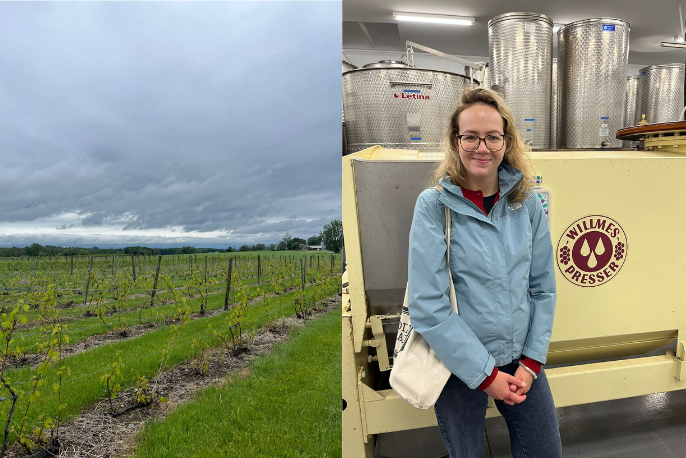
The transition from dairy farming to viticulture required new knowledge, new markets and new business models. The vineyard has also diversified through agritourism, demonstrating how rural enterprises increasingly combine food production with hospitality and community engagement. At the same time, climate change is creating new challenges. Historically, Vermont vineyards could produce ice wine using naturally frozen grapes, but warmer winters are making this increasingly difficult.
Food systems transformation was discussed as an ongoing process rather than a final destination. The vineyard's story illustrated how producers continually adapt to changing environmental and economic conditions while attempting to maintain rural livelihoods.
Climate change and environmental justice
Another standout session, Maple Matters, explored Vermont's maple syrup industry. Climate change emerged as a recurring concern. Producers are reporting greater variability in maple sap flows, sap quality, and tapping seasons, creating challenges for labour planning and production management.
The session also explored lead and PFAS ('forever chemicals') contamination in urban environments, resulting from historical waste disposal and the previous application of firefighting foams. This issue is particularly relevant for hobbyist maple producers tapping trees in urban and residential environments. Because maple trees have relatively shallow root systems, contaminants can enter the sap, raising important questions about food safety.
What interested me most was how the discussion connected environmental sustainability, public health and rural livelihoods. The challenges facing maple producers are not simply technical issues; they are also questions about who bears environmental risks and how those risks are managed. The discussion highlighted how environmental burdens are often unevenly distributed, raising broader questions about justice, responsibility, and resilience within food systems.
Trust and food system change
Questions of trust surfaced repeatedly throughout the conference. The presidential address by Jennifer Otten, challenged assumptions about political polarisation, suggesting that people may be less divided on food issues than public discourse often implies. A related discussion emerged during a roundtable on the Make America Healthy Again (MAHA) movement. While participants were critical of many of the movement's claims, they also recognised that its popularity reflects broader concerns about health, nutrition, and trust in institutions. One panellist described MAHA as offering 'bad answers to good questions', a phrase that captured the complexity of the discussion. Rather than focusing solely on the movement itself, the discussion touched on the importance of understanding why people feel disconnected from established institutions.
This raised an important question: how can food system transformations succeed if they fail to build public trust?
Rethinking reformulation as a food system solution
I presented research examining the impact of food and drink reformulation on health and environmental outcomes, conducted as part of the SHIFT project. Reformulation, where the product ingredients are changed, is frequently promoted as a way to improve population health while supporting more sustainable food systems.
Our initial findings suggest that reformulation has had relatively little impact on both health and environmental outcomes. While reformulation is often promoted as a win-win strategy for health and sustainability, our analysis suggests that its contribution to national nutrition and environmental goals has been limited.
Presenting this work in the context of a conference on just transformations encouraged my own reflection on the limits of incremental change. While reformulation is often presented as a practical solution, our findings suggest that small product-level changes alone may contribute little to broadened nutrition and sustainability goals. This raises important questions about whether current approaches place too much emphasis on technical fixes while overlooking the structural changes needed to create healthier and more sustainable food systems.
Final reflections
Reflecting on the whole conference, I was struck by how often discussions returned to questions of adaptation, agency, trust, and the limits of incremental change.
The keynote panel demonstrated how food systems can contribute to public health and community wellbeing. The vineyard visit showed how agricultural businesses adapt to changing conditions, while the session on maple syrup highlighted the environmental pressures facing hobbyist producers. Discussions of public health and political polarisation underscored the importance of trust in shaping food system futures, while our own research raised questions about whether widely promoted technical interventions can deliver meaningful change at the scale required to address today's food system challenges.
If there was one lesson from Vermont it was that a just transformation is not a destination but a continous process of negotiating how food systems 'serve' people, communities and the environment. Building more sustainable, equitable and resilient food systems will require not only technical innovation, but also participation, agency and a commitment to a just transformation.